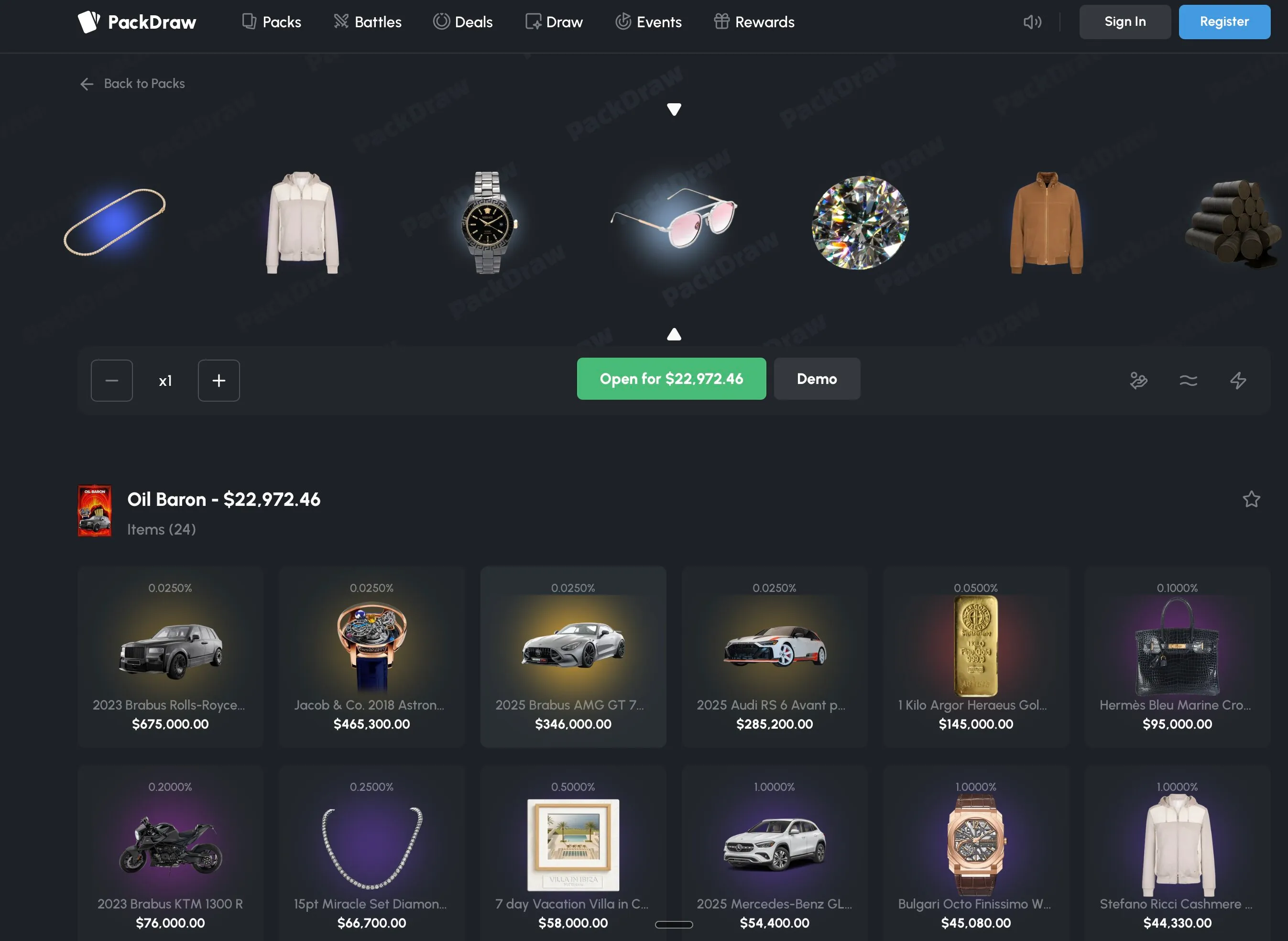
Mystery Box Odds Explained
Mystery box odds are the published probability of winning each item in a box — and on a reputable site you can see them before you buy and verify them afterward. The number that actually matters, though, is not any single prize’s odds but the box’s expected value: multiply each prize’s value by its probability, add them up, and you get the average return. On almost every box that average is below the price, because the site keeps a margin called the house edge. This guide explains how the odds are shown, what RTP, EV, and house edge mean, and how to read any box in under a minute.
How mystery box odds are shown
Every legitimate mystery box lists the exact probability of each possible prize before you open it. You will usually see a table or list: each item, its value, and its drop chance (for example, “Rolex — 0.2%”). The chances across all items add up to roughly 100%.
If a site does not show per-item odds, treat that as a red flag — see how to spot a scam mystery box site. On provably-fair platforms you can also confirm, after opening, that the result matched those published odds; here is how provably fair works.
RTP, house edge, and expected value
These three terms describe the same thing from different angles: how much of your money a box gives back on average. They are the most important numbers in the whole category.
- Expected value (EV) — the average payout of one box, found by multiplying each prize’s value by its probability and adding them up.
- RTP (return to player) — the EV as a percentage of the box price. An 80% RTP means you get back about $80 of value per $100 spent, on average.
- House edge — simply 100% − RTP. It is the site’s built-in margin; an 80% RTP is a 20% house edge.
Because the house edge is always positive, RTP is always below 100%, so the average player spends more than they receive.
| Term | What it means | Rule of thumb |
|---|---|---|
| Expected value | Average payout of one box | Compare to the price |
| RTP | Average value returned per dollar | 75%+ is decent for the category |
| House edge | The site’s margin (100% − RTP) | Lower is better; avoid 85%+ |
What are good mystery box odds?
In our testing, mystery boxes typically return roughly 65–80% of their price when you sell items back, which is a 20–35% house edge. Shipping and reselling a physical prize yourself can recover more — up to around 90% on the best sites — because you skip the site’s discounted buy-back rate. The worst value is usually on premium “luxury” boxes, where the house edge can approach 90%.
So “good odds” for a mystery box does not mean you profit — it means a smaller-than-average house edge and a realistic shot at the mid-tier prizes, not just the jackpot.
How to read and compare box odds in under a minute
Ignore the headline jackpot and look at where the probability actually sits. A fast way to judge any box:
- Find the big prizes’ odds. A 0.1% chance at a $10,000 watch adds only $10 of expected value — it barely moves the average.
- Look at the common outcomes. The items with 20–60% odds are what you will usually get; if they are near-worthless, the box is poor value.
- Estimate the EV, or just run it through a calculator (below). Compare that EV to the price.
- Check the house edge. If the box returns well under 65% of its price on average, walk away.
How to calculate any box’s real return
You don’t have to do the math by hand — our calculator does it instantly. Enter a box’s price and its prize list (value + drop chance for each item) into the True Odds calculator and it shows the RTP, house edge, expected loss per open, and your expected net over many opens. It is the fastest way to see through a box’s marketing before you spend. For the broader “is it worth it” question, see are mystery boxes worth it?, and for the full model, how mystery boxes work.
Frequently asked questions
What are mystery box odds? They are the published probability of winning each item in a box. Reputable sites show them before you buy, and provably-fair sites let you verify that your result matched them afterward.
What is a good RTP for a mystery box? Roughly 75% or higher is decent for this category; in our testing most boxes land around 65–80% on sell-back. Below about 60% is very poor value, and luxury boxes are often the worst.
Can you calculate mystery box odds yourself? Yes. Multiply each prize’s value by its probability and add them up to get the expected value, then divide by the box price for the RTP. Our True Odds calculator does this automatically.
Do better odds mean I’ll make money? No. Even the best mystery box odds carry a house edge, so the average return is below the price. Better odds just mean you lose less on average. Treat boxes as entertainment.
Independent guide. No brand pays for placement. 18+. Mystery box openings carry a house edge; treat them as entertainment, not a way to make money. Last updated October 2026.